Professor — AI for Cybersecurity & Threat Intelligence
Dr. Ananya Rao
PhD, GCTI
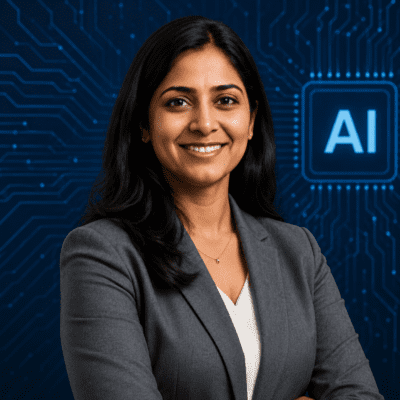
Researches the intersection of artificial intelligence and security, from ML-driven detection to AI threat intelligence.
Dr. Ananya Rao is a Professor of AI for Cybersecurity and Threat Intelligence at GICCT, where she leads the institute’s work at the rapidly evolving intersection of artificial intelligence and security. As machine learning reshapes both how organisations defend themselves and how adversaries attack, she helps students navigate a frontier where the rules are still being written.
Background and career
Dr. Rao trained as a data scientist before turning her attention to security, drawn by the realisation that the techniques powering recommendation engines and fraud detection could be applied to one of the hardest problems in computing: finding the signal of an attack in overwhelming noise. She built machine-learning detection systems for organisations drowning in security telemetry, where the challenge was never a shortage of data but a shortage of meaning.
Her doctoral research focused on adversarial machine learning — the study of how attackers can deceive AI systems, and how those systems can be made robust. That work gave her a dual perspective rare in the field: she understands both how to use AI to defend, and how AI itself becomes a target. She has since advised organisations on building threat intelligence capabilities and on the security risks introduced by their own growing reliance on AI systems.
Areas of expertise
Dr. Rao’s expertise spans machine learning for threat detection, anomaly detection, security analytics, and threat intelligence — the discipline of understanding adversaries well enough to anticipate them. She has particular depth in the security of AI systems themselves, an area of growing urgency as organisations deploy models into production without fully understanding their attack surface.
She is also fluent in the practical realities of threat intelligence: how to collect it, how to assess its reliability, and how to turn it into action rather than letting it pile up as unread reports. She emphasises that intelligence is only valuable when it changes a decision, and she teaches students to focus relentlessly on that test.
Teaching philosophy
Dr. Rao teaches a subject that attracts considerable hype, and she works hard to cut through it. Her courses ground students in what AI can genuinely do for security, what it cannot, and where the marketing outpaces the reality. She believes the most dangerous practitioner is one who treats a machine-learning model as a black box that simply produces answers, and she insists her students understand what is happening beneath the surface.
Her teaching is hands-on: students work with real datasets, build and evaluate detection models, and confront the messy practical problems — false positives, data quality, model drift — that determine whether an AI security system succeeds or fails in production. She wants graduates who can deploy these techniques responsibly and explain their limitations honestly.
A practitioner’s perspective
Dr. Rao keeps close to a field that moves faster than almost any other in security. The capabilities of AI systems, the techniques for attacking them, and the regulatory attention they attract are all changing rapidly, and she continually updates her teaching to reflect that. She helps students see not just where the field stands today but where it is heading, so they graduate prepared for the problems of the next few years rather than the last.
She is candid that AI is a tool, not a solution — a powerful amplifier of human judgement rather than a replacement for it. That measured view, neither dismissive nor credulous, is something she considers essential for anyone working at this intersection, and it runs through everything she teaches.
At GICCT
At the institute, Dr. Rao leads the curriculum on AI for cybersecurity and threat intelligence and contributes to the broader analytics and detection content. She is a strong advocate for evidence over hype, regularly reminding students that the goal is better security outcomes, not impressive-sounding technology. For professionals looking to work at the meeting point of data science and security — one of the most in-demand combinations in the industry — her courses offer both the technical foundation and the critical perspective the field badly needs.